
Machine Learning Q and AI
30 Essential Questions and Answers on Machine Learning and AI
By Sebastian Raschka. Free to read.
Published by No Starch Press.
Copyright © 2024-2025 by Sebastian Raschka.
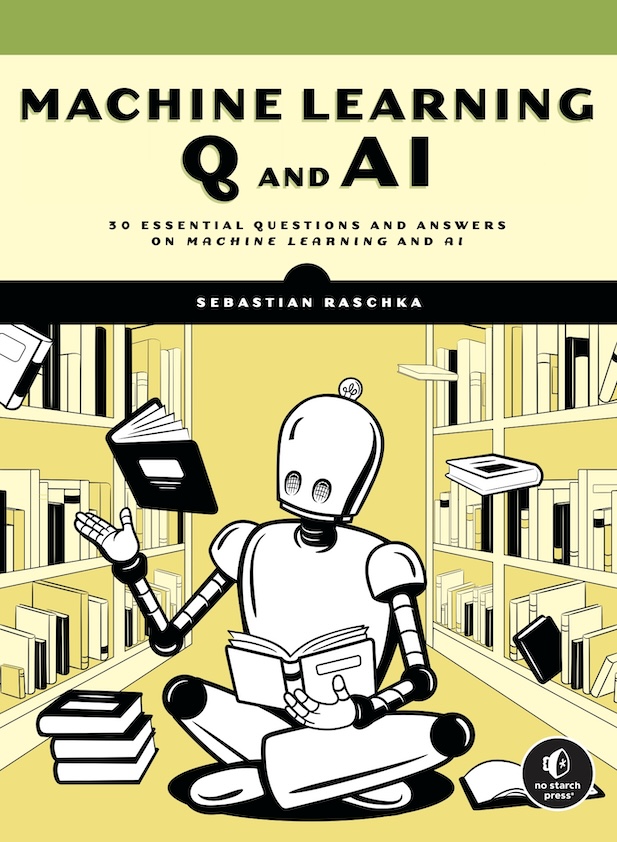
Machine learning and AI are moving at a rapid pace. Researchers and practitioners are constantly struggling to keep up with the breadth of concepts and techniques. This book provides bite-sized bits of knowledge for your journey from machine learning beginner to expert, covering topics from various machine learning areas. Even experienced machine learning researchers and practitioners will encounter something new that they can add to their arsenal of techniques.
📘 Print Book:
Amazon
No Starch Press
📄 Read Online:
Full Book (Free)
Introduction
Thanks to rapid advancements in deep learning, we have seen a significant expansion of machine learning and AI in recent years.
This progress is exciting if we expect these advancements to create new industries, transform existing ones, and improve the quality of life for people around the world. On the other hand, the constant emergence of new techniques can make it challenging and time-consuming to keep abreast of the latest developments. Nonetheless, staying current is essential for professionals and organizations that use these technologies.
I wrote this book as a resource for readers and machine learning practitioners who want to advance their expertise in the field and learn about techniques that I consider useful and significant but that are often overlooked in traditional and introductory textbooks and classes. I hope you’ll find this book a valuable resource for obtaining new insights and discovering new techniques you can implement in your work.
Who Is This Book For?
Navigating the world of AI and machine learning literature can often feel like walking a tightrope, with most books positioned at either end: broad beginner’s introductions or deeply mathematical treatises. This book illustrates and discusses important developments in these fields while staying approachable and not requiring an advanced math or coding background.
This book is for people with some experience with machine learning who want to learn new concepts and techniques. It’s ideal for those who have taken a beginner course in machine learning or deep learning or have read an equivalent introductory book on the topic. (Throughout this book, I will use machine learning as an umbrella term for machine learning, deep learning, and AI.)
What Will You Get Out of This Book?
This book adopts a unique Q&A style, where each brief chapter is structured around a central question related to fundamental concepts in machine learning, deep learning, and AI. Every question is followed by an explanation, with several illustrations and figures, as well as exercises to test your understanding. Many chapters also include references for further reading. These bite-sized nuggets of information provide an enjoyable jumping-off point on your journey from machine learning beginner to expert.
The book covers a wide range of topics. It includes new insights about established architectures, such as convolutional networks, that allow you to utilize these technologies more effectively. It also discusses more advanced techniques, such as the inner workings of large language models (LLMs) and vision transformers. Even experienced machine learning researchers and practitioners will encounter something new to add to their arsenal of techniques.
While this book will expose you to new concepts and ideas, it’s not a math or coding book. You won’t need to solve any proofs or run any code while reading. In other words, this book is a perfect travel companion or something you can read on your favorite reading chair with your morning coffee or tea.
How to Read This Book
Each chapter of this book is designed to be self-contained, offering you the freedom to jump between topics as you wish. When a concept from one chapter is explained in more detail in another, I’ve included chapter references you can follow to fill in gaps in your understanding.
However, there’s a strategic sequence to the chapters. For example,
the early chapter on embeddings sets the stage for later discussions
on self-supervised learning and few-shot learning. For the easiest reading
experience and the most comprehensive grasp of the content, my
recommendation is to approach the book from start to finish.
Each chapter is accompanied by optional exercises for readers who want to test their understanding, with an answer key located at the end of the book. In addition, for any papers referenced in a chapter or further reading on that chapter’s topic, you can find the complete citation information in that chapter’s “References” section.
The book is structured into five main parts centered on the most important topics in machine learning and AI today.
Part I: Neural Networks and Deep Learning covers questions about deep neural networks and deep learning that are not specific to a particular subdomain. For example, we discuss alternatives to supervised learning and techniques for reducing overfitting, which is a common problem when using machine learning models for real-world problems where data is limited.
Chapter [ch01]: Embeddings, Latent Space, and Representations
Delves into the distinctions and similarities between embedding vectors,
latent vectors, and representations. Elucidates how these concepts help
encode information in the context of machine learning.
Chapter [ch02]: Self-Supervised Learning
Focuses on self-supervised learning, a method that allows neural
networks to utilize large, unlabeled datasets in a supervised manner.
Chapter [ch03]: Few-Shot Learning
Introduces few-shot learning, a specialized supervised learning
technique tailored for small training datasets.
Chapter [ch04]: The Lottery Ticket Hypothesis
Explores the idea that ran-
domlyinitializedneuralnetworkscontainsmaller,efficient subnetworks.
Chapter [ch05]: Reducing Overfitting with Data
Addresses the challenge of overfitting in machine learning, discussing
strategies centered on data augmentation and the use of unlabeled data
to reduce overfitting.
Chapter [ch06]: Reducing Overfitting with Model Modifications
Extends the conversation on overfitting, focusing on model-related
solutions like regularization, opting for simpler models, and ensemble
techniques.
Chapter [ch07]: Multi-GPU Training Paradigms
Explains various training paradigms for multi-GPU setups to accelerate
model training, including data and model parallelism.
Chapter [ch08]: The Success of Transformers
Explores the popular transformer architecture, highlighting features
like attention mechanisms, parallelization ease, and high parameter
counts.
Chapter [ch09]: Generative AI Models
Provides a comprehensive overview of deep generative models, which are
used to produce various media forms, including images, text, and audio.
Discusses the strengths and weaknesses of each model type.
Chapter [ch10]: Sources of Randomness
Addresses the various sources of randomness in the training of deep
neural networks that may lead to inconsistent and non-reproducible
results during both training and inference. While randomness can be
accidental, it can also be intentionally introduced by design.
Part II: Computer Vision focuses on topics mainly related to deep learning but specific to computer vision, many of which cover convolutional neural networks and vision transformers.
Chapter [ch11]: Calculating the Number of Parameters
Explains the
procedure for determining the parameters in a convolutional neural
network, which is useful for gauging a model’s storage and memory
requirements.
Chapter [ch12]: Fully Connected and Convolutional Layers
Illustrates the circumstances in which convolutional layers can
seamlessly replace fully connected layers, which can be useful for
hardware optimization or simplifying implementations.
Chapter [ch13]: Large Training Sets for Vision Transformers
Probes the rationale behind vision transformers requiring more extensive
training sets compared to conventional convolutional neural networks.
Part III: Natural Language Processing covers topics around working with text, many of which are related to transformer architectures and self-attention.
Chapter [ch14]: The Distributional Hypothesis
Delves into the distributional hypothesis, a linguistic theory
suggesting that words appearing in the same contexts tend to possess
similar meanings, which has useful implications for training machine
learning models.
Chapter [ch15]: Data Augmentation for Text
Highlights the significance of data augmentation for text, a technique
used to artificially increase dataset sizes, which can help with
improving model performance.
Chapter [ch16]: Self-Attention
Introduces self-attention, a mechanism allowing each segment of a neural
network’s input to refer to other parts. Self-attention is a key
mechanism in modern large language models.
Chapter [ch17]: Encoder- and Decoder-Style Transformers
Describes
the nuances of encoder and decoder transformer architectures and
explains which type of architecture is most useful for each language
processing task.
Chapter [ch18]: Using and Fine-Tuning Pretrained Transformers
Explains different methods for fine-tuning pretrained large language
models and discusses their strengths and weaknesses.
Chapter [ch19]: Evaluating Generative Large Language Models
Lists pro-
minent evaluation metrics for language models like Perplexity, BLEU,
ROUGE, and BERTScore.
Part IV: Production and Deployment covers questions pertaining to practical scenarios, such as increasing inference speeds and various types of distribution shifts.
Chapter [ch20]: Stateless and Stateful Training
Distinguishes between stateless and stateful training methodologies used
in deploying models.
Chapter [ch21]: Data-Centric AI
Explores data-centric AI, which priori-
tizes refining datasets to enhance model performance. This approach
contrasts with the conventional model-centric approach, which emphasizes
improving model architectures or methods.
Chapter [ch22]: Speeding Up Inference
Introduces techniques to enhance the speed of model inference without
tweaking the model’s architecture or compromising accuracy.
Chapter [ch23]: Data Distribution Shifts
Post-deployment, AI models
may face discrepancies between training data and real-world data
distributions, known as data distribution shifts. These shifts can
deteriorate model performance. This chapter categorizes and elaborates
on common shifts like covariate shift, concept drift, label shift, and
do-
main shift.
Part V: Predictive Performance and Model Evaluation dives deeper into various aspects of squeezing out predictive performance, such as changing the loss function, setting up k-fold cross-validation, and dealing with limited labeled data.
Chapter [ch24]: Poisson and Ordinal Regression
Highlights the differences between Poisson and ordinal regression.
Poisson regression is suitable for count data that follows a Poisson
distribution, like the number of colds contracted on an airplane. In
contrast, ordinal regression caters to ordered categorical data without
assuming equidistant categories, such as disease severity.
Chapter [ch25]: Confidence Intervals
Delves into methods for constructing confidence intervals for machine
learning classifiers. Reviews the purpose of confidence intervals,
discusses how they estimate unknown population parameters, and
introduces techniques such as normal approximation intervals,
bootstrapping, and retraining with various random seeds.
Chapter [ch26]: Confidence Intervals vs. Conformal Predictions
Discusses the distinction between confidence intervals and conformal
predictions and describes the latter as a tool for creating prediction
intervals that cover actual outcomes with specific probability.
Chapter [ch27]: Proper Metrics
Focuses on the essential properties of a proper metric in mathematics
and computer science. Examines whether commonly used loss functions in
machine learning, such as mean squared error and cross-entropy loss,
satisfy these properties.
Chapter [ch28]: The k in k-Fold Cross-Validation
Explores the role of the k in k-fold cross-validation and provides
insight into the advantages and disadvantages of selecting a large k.
Chapter [ch29]: Training and Test Set Discordance
Addresses the scenario where a model performs better on a test dataset than the training dataset. Offers strategies to discover and address discrepancies
between training and test datasets, introducing the concept of adversarial validation.
Chapter [ch30]: Limited Labeled Data
Introduces various techniques to enhance model performance in situations
where data is limited. Covers data labeling, bootstrapping, and
paradigms such as transfer learning, active learning, and multimodal
learning.
Online Resources
I’ve provided optional supplementary materials on GitHub with code examples for certain chapters to enhance your learning experience (see https://github.com/rasbt/MachineLearning-QandAI-book). These materials are designed as practical extensions and deep dives into topics covered in the book. You can use them alongside each chapter or explore them after reading to solidify and expand your knowledge.
Without further ado, let’s dive in.
Support the Author
You can support the author in the following ways:
- Subscribe to Sebastian's Substack blog
- Purchase a copy on Amazon or No Starch Press
- Write an Amazon review