
Machine Learning Q and AI
30 Essential Questions and Answers on Machine Learning and AI
By Sebastian Raschka. Free to read.
Published by No Starch Press.
Copyright © 2024-2025 by Sebastian Raschka.

Machine learning and AI are moving at a rapid pace. Researchers and practitioners are constantly struggling to keep up with the breadth of concepts and techniques. This book provides bite-sized bits of knowledge for your journey from machine learning beginner to expert, covering topics from various machine learning areas. Even experienced machine learning researchers and practitioners will encounter something new that they can add to their arsenal of techniques.
📘 Print Book:
Amazon
No Starch Press
📄 Read Online:
Full Book (Free)
Chapter 29: Training and Test Set Discordance
Suppose we train a model that performs much better on the test dataset than on the training dataset. Since a similar model configuration previously worked well on a similar dataset, we suspect something might be unusual with the data. What are some approaches for looking into training and test set discrepancies, and what strategies can we use to mitigate these issues?
Before investigating the datasets in more detail, we should check for technical issues in the data loading and evaluation code. For instance, a simple sanity check is to temporarily replace the test set with the training set and to reevaluate the model. In this case, we should see identical training and test set performances (since these datasets are now identical). If we notice a discrepancy, we likely have a bug in the code; in my experience, such bugs are frequently related to incorrect shuffling or inconsistent (often missing) data normalization.
If the test set performance is much better than the training set performance, we can rule out overfitting. More likely, there are substantial diff- erences in the training and test data distributions. These distributionaldifferences may affect both the features and the targets. Here, plotting the target or label distributions of training and test data is a good idea. For example, a common issue is that the test set is missing certain class labels if the dataset was not shuffled properly before splitting it into training and test data. For small tabular datasets, it is also feasible to compare feature distributions in the training and test sets using histograms.
Looking at feature distributions is a good approach for tabular data, but this is trickier for image and text data. A relatively easy and more general approach to check for discrepancies between training and test sets is adversarial validation.
Adversarial validation, illustrated in Figure [fig:ch29-fig01], is a technique to identify the degree of similarity between the training and test data. We first merge the training and test sets into a single dataset, and then we create a binary target variable that distinguishes between training and test data. For instance, we can use a new Is test? label where we assign the label 0 to training data and the label 1 to test data. We then use k-fold cross-validation or repartition the dataset into a training set and a test set and train a machine learning model as usual. Ideally, we want the model to perform poorly, indicating that the training and test data distributions are similar. On the other hand, if the model performs well in predicting the Is test? label, it suggests a discrepancy between the training and test data that we need to investigate further.
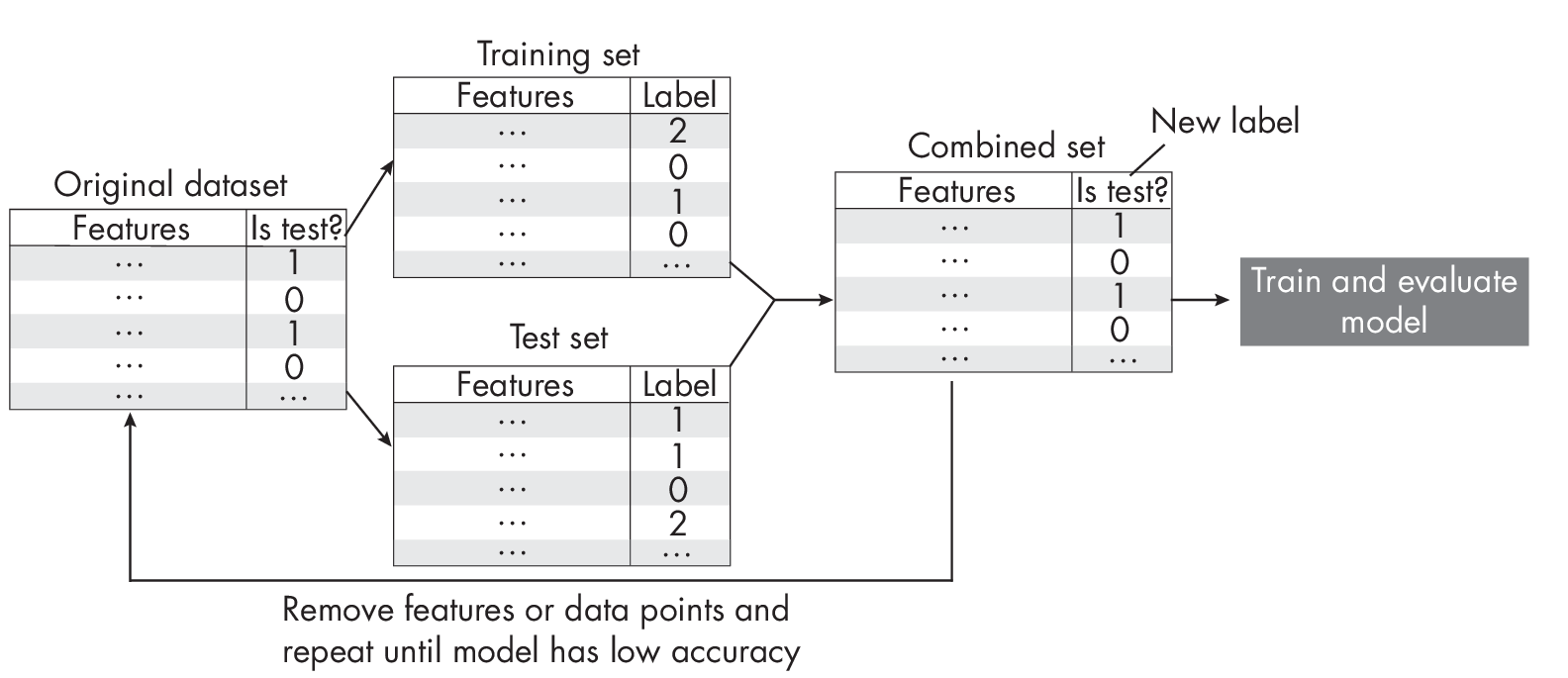
What mitigation techniques should we use if we detect a training–test set discrepancy using adversarial validation? If we’re working with a tabular dataset, we can remove features one at a time to see if this helps address the issue, as spurious features can sometimes be highly correlated with the target variable. To implement this strategy, we can use sequential feature selection algorithms with an updated objective. For example, instead of maximizing classification accuracy, we can minimize classification accuracy. For cases where removing features is not so trivial (such as with image and text data), we can also investigate whether removing individual training instances that are different from the test set can address the discrepancy issue.
Exercises
29-1. What is a good performance baseline for the adversarial prediction task?
29-2. Since training datasets are often bigger than test datasets, adversarial validation often results in an imbalanced prediction problem (with a majority of examples labeled as Is test? being false instead of true). Is this an issue, and if so, how can we mitigate that?
Support the Author
You can support the author in the following ways:
- Subscribe to Sebastian's Substack blog
- Purchase a copy on Amazon or No Starch Press
- Write an Amazon review