
Machine Learning Q and AI
30 Essential Questions and Answers on Machine Learning and AI
By Sebastian Raschka. Free to read.
Published by No Starch Press.
Copyright © 2024-2025 by Sebastian Raschka.

Machine learning and AI are moving at a rapid pace. Researchers and practitioners are constantly struggling to keep up with the breadth of concepts and techniques. This book provides bite-sized bits of knowledge for your journey from machine learning beginner to expert, covering topics from various machine learning areas. Even experienced machine learning researchers and practitioners will encounter something new that they can add to their arsenal of techniques.
📘 Print Book:
Amazon
No Starch Press
📄 Read Online:
Full Book (Free)
Part 4: Predictive Performance and Model Evaluation
Chapter 24: Poisson and Ordinal Regression
When is it preferable to use Poisson regression over ordinal regression, and vice versa?
We usually use Poisson regression when the target variable represents count data (positive integers). As an example of count data, consider the number of colds contracted on an airplane or the number of guests visiting a restaurant on a given day. Besides the target variable representing counts, the data should also be Poisson distributed, which means that the mean and variance are roughly the same. (For large means, we can use a normal distribution to approximate a Poisson distribution.)
Ordinal data is a subcategory of categorical data where the categories have a natural order, such as 1 < 2 < 3, as illustrated in Figure 1.1. Ordinal data is often represented as positive integers and may look similar to count data. For example, consider the star rating on Amazon (1 star, 2 stars, 3 stars, and so on). However, ordinal regression does not make any assumptions about the distance between the ordered categories. Consider the following measure of disease severity: severe > moderate > mild > none. While we would typically map the disease severity variable to an integer representation (4 > 3 > 2 > 1), there is no assumption that the distance between 4 and 3 (severe and moderate) is the same as the distance between 2 and 1 (mild and none).
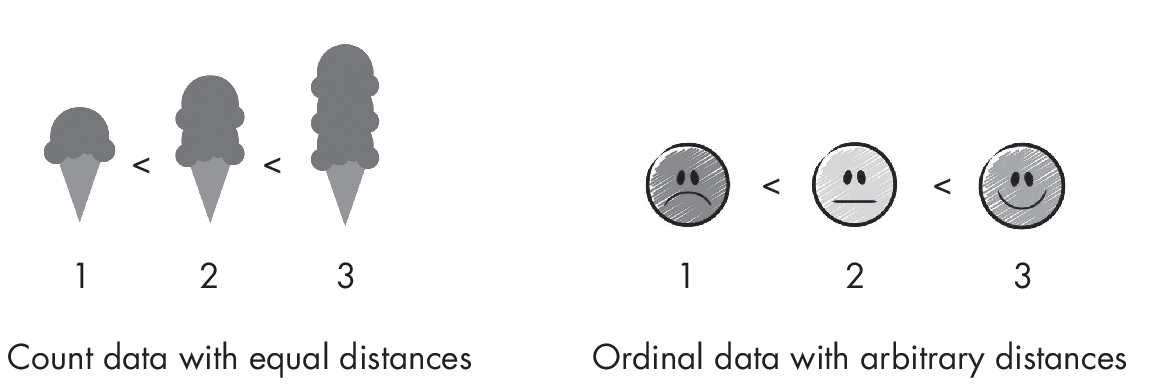
In short, we use Poisson regression for count data. We use ordinal regression when we know that certain outcomes are “higher” or “lower” than others, but we are not sure how much or if it even matters.
Exercises
24-1. Suppose we want to predict the number of goals a soccer player will score in a particular season. Should we solve this problem using ordinal regression or Poisson regression?
24-2. Suppose we ask someone to sort the last three movies they have watched based on their order of preference. Ignoring the fact that this dataset is a tad too small for machine learning, which approach would be best suited for this kind of data?
Support the Author
You can support the author in the following ways:
- Subscribe to Sebastian's Substack blog
- Purchase a copy on Amazon or No Starch Press
- Write an Amazon review