
Machine Learning Q and AI
30 Essential Questions and Answers on Machine Learning and AI
By Sebastian Raschka. Free to read.
Published by No Starch Press.
Copyright © 2024-2025 by Sebastian Raschka.

Machine learning and AI are moving at a rapid pace. Researchers and practitioners are constantly struggling to keep up with the breadth of concepts and techniques. This book provides bite-sized bits of knowledge for your journey from machine learning beginner to expert, covering topics from various machine learning areas. Even experienced machine learning researchers and practitioners will encounter something new that they can add to their arsenal of techniques.
📘 Print Book:
Amazon
No Starch Press
📄 Read Online:
Full Book (Free)
Chapter 19: Evaluating Generative Large Language Models
What are the standard metrics for evaluating the quality of text generated by large language models, and why are these metrics useful?
Perplexity, BLEU, ROUGE, and BERTScore are some of the most common evaluation metrics used in natural language processing to assess the performance of LLMs across various tasks. Although there is ultimately no way around human quality judgments, human evaluations are tedious, expensive, hard to automate, and subjective. Hence, we develop metrics to provide objective summary scores to measure progress and compare different approaches.
This chapter discusses the difference between intrinsic and extrinsic performance metrics for evaluating LLMs, and then it dives deeper into popular metrics like BLEU, ROUGE, and BERTScore and provides simple hands-on examples for illustration purposes.
Evaluation Metrics for LLMs
The perplexity metric is directly related to the loss function used for pretraining LLMs and is commonly used to evaluate text generation and text completion models. Essentially, it quantifies the average uncertainty of the model in predicting the next word in a given context—the lower the perplexity, the better.
The bilingual evaluation understudy (BLEU) score is a widely used metric for evaluating the quality of machine-generated translations. It measures the overlap of n-grams between the machine-generated translation and a set of human-generated reference translations. A higher BLEU score indicates better performance, ranging from 0 (worst) to 1 (best).
The recall-oriented understudy for gisting evaluation (ROUGE) score is a metric primarily used for evaluating automatic summarization (and sometimes machine translation) models. It measures the overlap between the generated summary and reference summaries.
We can think of perplexity as an intrinsic metric and BLEU and ROUGE as extrinsic metrics. To illustrate the difference between the two types of metrics, think of optimizing the conventional cross entropy to train an image classifier. The cross entropy is a loss function we optimize during training, but our end goal is to maximize the classification accuracy. Since classification accuracy cannot be optimized directly during training, as it’s not differentiable, we minimize the surrogate loss function like the cross entropy. Minimizing the cross entropy loss more or less correlates with maximizing the classification accuracy.
Perplexity is often used as an evaluation metric to compare the performance of different language models, but it is not the optimization target during training. BLEU and ROUGE are more related to classification accuracy, or rather precision and recall. In fact, BLEU is a precision-like score to evaluate the quality of a translated text, while ROUGE is a recall-like score to evaluate summarized texts.
The following sections discuss the mechanics of these metrics in more detail.
Perplexity
Perplexity is closely related to the cross entropy directly minimized during training, which is why we refer to perplexity as an intrinsic metric.
Perplexity is defined as 2H(p, q)/n, where H(p, q) is the cross entropy between the true distribution of words p and the predicted distribution of words q, and n is the sentence length (the number of words or tokens) to normalize the score. As cross entropy decreases, perplexity decreases as well—the lower the perplexity, the better. While we typically compute the cross entropy using a natural logarithm, we calculate the cross entropy and perplexity with a base-2 logarithm for the intuitive relationship to hold. (However, whether we use a base-2 or natural logarithm is only a minor implementation detail.)
In practice, since the probability for each word in the target sentence is always 1, we compute the cross entropy as the logarithm of the probability scores returned by the model we want to evaluate. In other words, if we have the predicted probability score for each word in a sentence s, we can compute the perplexity directly as follows:
\[Perplexity(s) = 2^{-\frac{1}{n} \log_2 (p(s))}\]where s is the sentence or text we want to evaluate, such as “The quick brown fox jumps over the lazy dog,” p(s) is the probability scores returned by the model, and n is the number of words or tokens. For example, if the model returns the probability scores [0.99, 0.85, 0.89, 0.99, 0.99, 0.99, 0.99, 0.99], the perplexity is:
\[\begin{aligned} & 2^{-\frac{1}{8} \cdot \sum_i \log_2 p(w_i)} \\ =\,& 2^{-\frac{1}{8} \cdot \sum \log_2 (0.99 \,\times\, 0.85 \,\times\, 0.89 \,\times\, 0.99 \,\times\, 0.99 \,\times\, 0.99 \,\times\, 0.99 \,\times\, 0.99) }\\ =\,&1.043 \end{aligned}\]If the sentence was “The fast black cat jumps over the lazy dog,” with probabilities [0.99, 0.65, 0.13, 0.05, 0.21, 0.99, 0.99, 0.99], the corresponding perplexity would be 2.419.
You can find a code implementation and example of this calculation in the supplementary/q19-evaluation-llms subfolder at https://github.com/rasbt/MachineLearning-QandAI-book.
BLEU Score
BLEU is the most popular and most widely used metric for evaluating translated texts. It’s used in almost all LLMs capable of translation, including popular tools such as OpenAI’s Whisper and GPT models.
BLEU is a reference-based metric that compares the model output to human-generated references and was first developed to capture or automate the essence of human evaluation. In short, BLEU measures the lexical overlap between the model output and the human-generated references based on a precision score.
In more detail, as a precision-based metric, BLEU counts how many words in the generated text (candidate text) occur in the reference text divided by the candidate text length (the number of words), where the reference text is a sample translation provided by a human, for example. This is commonly done for n-grams rather than individual words, but for simplicity, we will stick to words or 1-grams. (In practice, BLEU is often computed for 4-grams.)
Figure [fig:ch19-fig01] demonstrates the BLEU score calculation, using the example of calculating the 1-gram BLEU score. The individual steps in Figure [fig:ch19-fig01] illustrate how we compute the 1-gram BLEU score based on its individual components, the weighted precision times a brevity penalty. You can also find a code implementation of this calculation in the supplementary/q15-text -augment subfolder at https://github.com/rasbt/MachineLearning-QandAI-book.
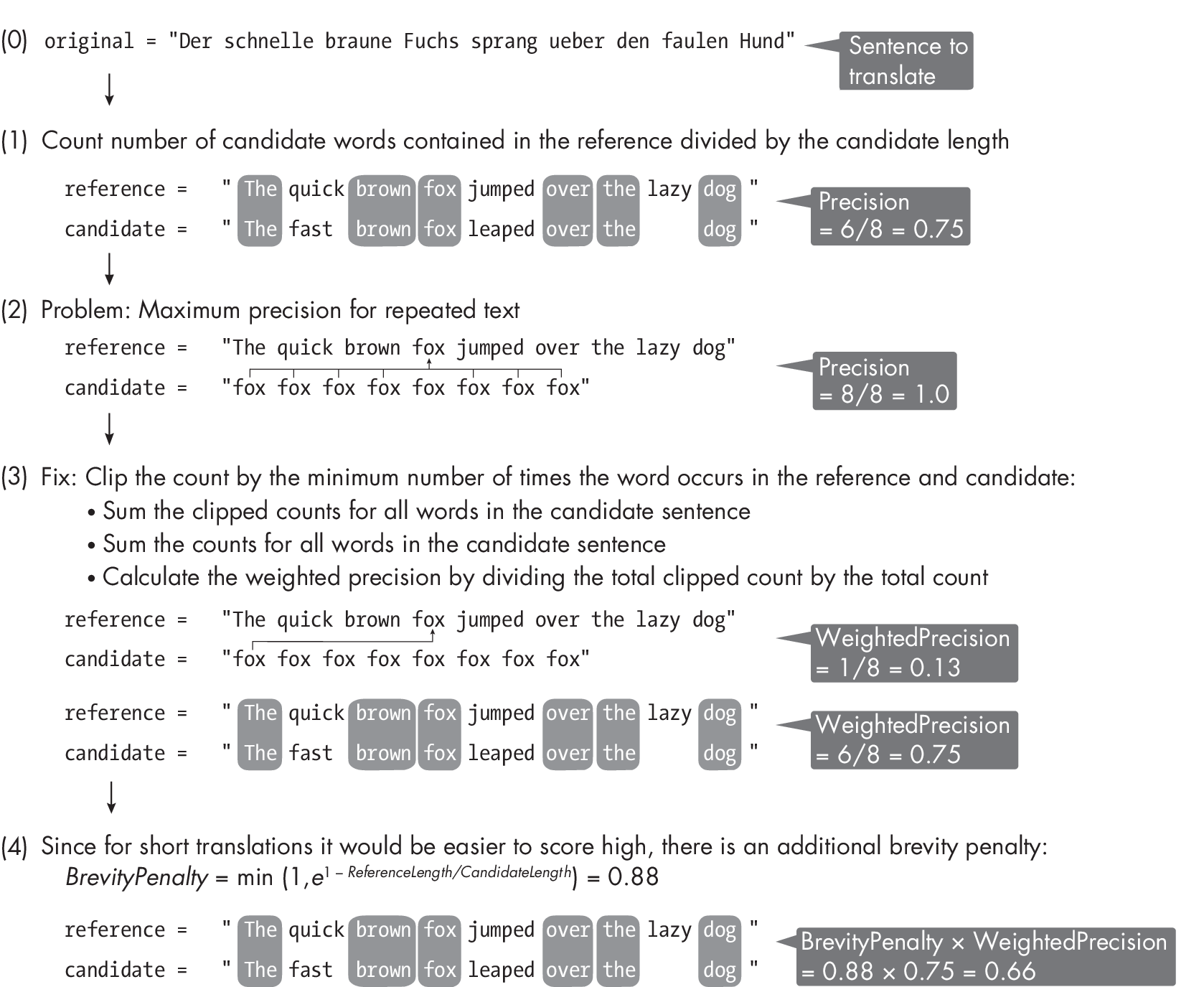
BLEU has several shortcomings, mostly owing to the fact that it measures string similarity, and similarity alone is not sufficient for capturing quality. For instance, sentences with similar words but different word orders might still score high, even though altering the word order can significantly change the meaning of a sentence and result in poor grammatical structure. Furthermore, since BLEU relies on exact string matches, it is sensitive to lexical variations and is incapable of identifying semantically similar translations that use synonyms or paraphrases. In other words, BLEU may assign lower scores to translations that are, in fact, accurate and meaningful.
The original BLEU paper found a high correlation with human evaluations, though this was disproven later.
Is BLEU flawed? Yes. Is it still useful? Also yes. BLEU is a helpful tool to measure or assess whether a model improves during training, as a proxy for fluency. However, it may not reliably give a correct assessment of the quality of the generated translations and is not well suited for detecting issues. In other words, it’s best used as a model selection tool, not a model evaluation tool.
Atthetimeofwriting,themostpopularalternativestoBLEUare METEOR and COMET (see the “” section at the end of this chapter for more details).
ROUGE Score
While BLEU is commonly used for translation tasks, ROUGE is a popular metric for scoring text summaries.
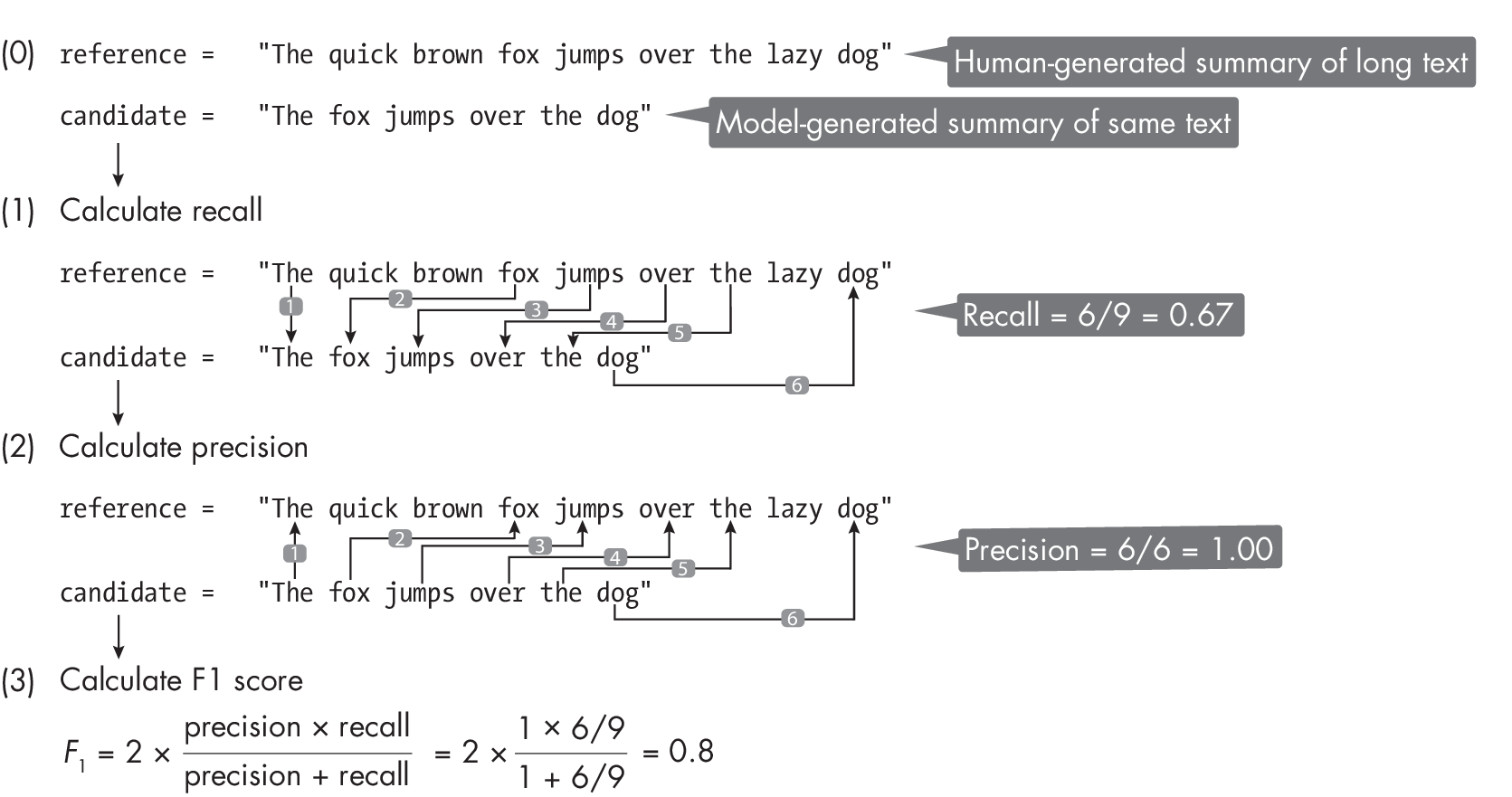
There are many similarities between BLEU and ROUGE. The precision-basedBLEUscorecheckshowmanywordsinthecandidatetranslation occur in the reference translation. The ROUGE score also takes a flipped approach, checking how many words in the reference text appear in the generated text (here typically a summarization instead of a translation); this can be interpreted as a recall-based score.
Modern implementations compute ROUGE as an F1 score that is the harmonic mean of recall (how many words in the reference occur in the candidate text) and precision (how many words in the candidate text occur in the reference text). For example, Figure [fig:ch19-fig02] shows a 1-gram ROUGE score computation (though in practice, ROUGE is often computed for bigrams, that is, 2-grams).
There are other ROUGE variants beyond ROUGE-1 (the F1 score–based ROUGE score for 1-grams):
ROUGE-N Measures the overlap of n-grams between the candidate and reference summaries. For example, ROUGE-1 would look at the overlap of individual words (1-grams), while ROUGE-2 would consider the overlap of 2-grams (bigrams).
ROUGE-L Measures the longest common subsequence (LCS) between the candidate and reference summaries. This metric captures the longest co-occurring in-order subsequence of words, which may have gaps in between them.
ROUGE-S Measures the overlap of skip-bigrams, or word pairs with a flexible number of words in between them. It can be useful to capture the similarity between sentences with different word orderings.
ROUGE shares similar weaknesses with BLEU. Like BLEU, ROUGE does not account for synonyms or paraphrases. It measures the n-gram overlap between the candidate and reference summaries, which can lead to lower scores for semantically similar but lexically different sentences. However, it’s still worth knowing about ROUGE since, according to a study, all papers introducing new summarization models at computational linguistics conferences in 2021 used it, and 69 percent of those papers used only ROUGE.
BERTScore
Another more recently developed extrinsic metric is BERTScore.
Forreadersfamiliarwiththeinceptionscoreforgenerativevision models, BERTScore takes a similar approach, using embeddings from a pretrained model (for more on embeddings, see Chapter [ch01]). Here, BERT- Score measures the similarity between a candidate text and a reference text by leveraging the contextual embeddings produced by the BERT model (the encoder-style transformer discussed in Chapter [ch17]).
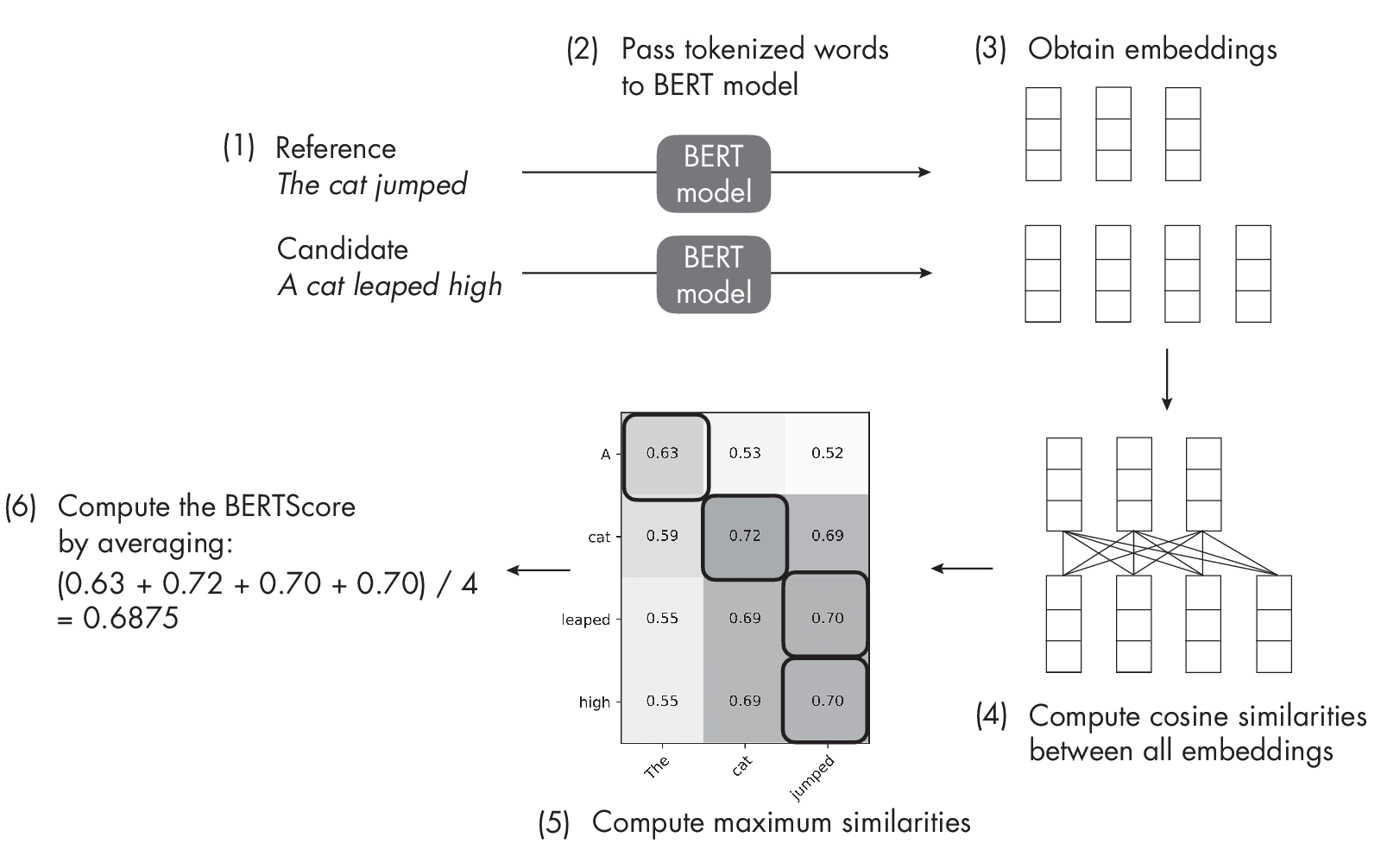
The steps to compute BERTScore are as follows:
-
Obtain the candidate text via the LLM you want to evaluate (PaLM, LLaMA, GPT, BLOOM, and so on).
-
Tokenize the candidate and reference texts into subwords, preferably using the same tokenizer used for training BERT.
-
Use a pretrained BERT model to create the embeddings for all tokens in the candidate and reference texts.
-
Compare each token embedding in the candidate text to all token embeddings in the reference text, computing their cosine similarity.
-
Align each token in the candidate text with the token in the reference text that has the highest cosine similarity.
-
Compute the final BERTScore by taking the average similarity scores of all tokens in the candidate text.
Figure [fig:ch19-fig03] further illustrates these six steps. You can also find a computational example in the subfolder/q15-text-augment subfolder at https://github.com/rasbt/MachineLearning-QandAI-book.
BERTScore can be used for translations and summaries, and it captures the semantic similarity better than traditional metrics like BLEU and ROUGE. However, BERTScore is more robust in paraphrasing than BLEU and ROUGE and captures semantic similarity better due to its contextual embeddings. Also, it may be computationally more expensive than BLEU and ROUGE, as it requires using a pretrained BERT model for the evaluation. While BERTScore provides a useful automatic evaluation metric, it’s not perfect and should be used alongside other evaluation techniques, including human judgment.
Surrogate Metrics
All metrics covered in this chapter are surrogates or proxies to evaluate how useful the model is in terms of measuring how well the model compares to human performance for accomplishing a goal. As mentioned earlier, the best way to evaluate LLMs is to assign human raters who judge the results. However, since this is often expensive and not easy to scale, we use the aforementioned metrics to estimate model performance. To quote from the InstructGPTpaper “Training Language Models to Follow Instructions with Human Feedback”: “Public NLP datasets are not reflective of how our language models are used . . . [They] are designed to capture tasks that are easy to evaluate with automatic metrics.”
Besides perplexity, ROUGE, BLEU, and BERTScore, several other popular evaluation metrics are used to assess the predictive performance of LLMs.
Exercises
19-1. In step 5 of Figure [fig:ch19-fig03], the cosine similarity between the two embeddings of “cat” is not 1.0, where 1.0 indicates a maximum cosine similarity. Why is that?
19-2. In practice, we might find that the BERTScore is not symmetric. This means that switching the candidate and reference sentences could result in different BERTScores for specific texts. How could we address this?
References
-
The paper proposing the original BLEU method: Kishore Papineni et al.,“BLEU: A Method for Automatic Evaluation of Machine Translation” (2002), https://aclanthology.org/P02-1040/.
-
A follow-up study disproving BLEU’s high correlation with human evaluations: Chris Callison-Burch, Miles Osborne, and Philipp Koehn, “Re-Evaluating the Role of BLEU in Machine Translation Research” (2006), https://aclanthology.org/E06-1032/.
-
The shortcomings of BLEU, based on 37 studies published over 20 years: Benjamin Marie, “12 Critical Flaws of BLEU” (2022), https://medium.com/@bnjmn_marie/12-critical-flaws-of-bleu-1d790ccbe1b1.
-
The paper proposing the original ROUGE method: Chin-Yew Lin, “ROUGE:APackageforAutomaticEvaluationofSummaries” (2004), https://aclanthology.org/W04-1013/.
-
A survey on the usage of ROUGE in conference papers: Sebastian Gehrmann, Elizabeth Clark, and Thibault Sellam, “Repairing the Cracked Foundation: A Survey of Obstacles in Evaluation Practices for Generated Text” (2022), https://arxiv.org/abs/2202.06935.
-
BERTScore, an evaluation metric based on a large language model: Tianyi Zhang et al., “BERTScore: Evaluating Text Generation with BERT” (2019), https://arxiv.org/abs/1904.09675.
-
A comprehensive survey on evaluation metrics for large language models: Asli Celikyilmaz, Elizabeth Clark, and Jianfeng Gao, “Evaluation of Text Generation: A Survey” (2021), https://arxiv.org/abs/2006.14799.
-
METEOR is a machine translation metric that improves upon BLEU by using advanced matching techniques and aiming for better correlationwithhumanjudgmentatthesentencelevel:SatanjeevBanerjee and Alon Lavie, “METEOR: An Automatic Metric for MT Evaluation with Improved Correlation with Human Judgments” (2005), https://aclanthology.org/W05-0909/.
-
COMET is a neural framework that sets new standards for correlating machine translation quality with human judgments, using cross-lingual pretrained models and multiple types of evaluation: Ricardo Rei et al., “COMET: A Neural Framework for MT Evaluation” (2020), https://arxiv.org/abs/2009.09025.
-
The InstructGPT paper: Long Ouyang et al., “Training Language Models to Follow Instructions with Human Feedback” (2022), https://arxiv.org/abs/2203.02155.
Support the Author
You can support the author in the following ways:
- Subscribe to Sebastian's Substack blog
- Purchase a copy on Amazon or No Starch Press
- Write an Amazon review