
Machine Learning Q and AI
30 Essential Questions and Answers on Machine Learning and AI
By Sebastian Raschka. Free to read.
Published by No Starch Press.
Copyright © 2024-2025 by Sebastian Raschka.
Machine learning and AI are moving at a rapid pace. Researchers and practitioners are constantly struggling to keep up with the breadth of concepts and techniques. This book provides bite-sized bits of knowledge for your journey from machine learning beginner to expert, covering topics from various machine learning areas. Even experienced machine learning researchers and practitioners will encounter something new that they can add to their arsenal of techniques.
📘 Print Book:
Amazon
No Starch Press
📄 Read Online:
Full Book (Free)
Chapter 17: Encoder- and Decoder-Style Transformers
What are the differences between encoder- and decoder-based language transformers?
Both encoder- and decoder-style architectures use the same self-attention layers to encode word tokens. The main difference is that encoders are designed to learn embeddings that can be used for various predictive modeling tasks such as classification. In contrast, decoders are designed to generate new texts, for example, to answer user queries.
This chapter starts by describing the original transformer architecture consisting of an encoder that processes input text and a decoder that produces translations. The subsequent sections then describe how models like BERT and RoBERTa utilize only the encoder to understand context and how the GPT architectures emphasize decoder-only mechanisms for text generation.
The Original Transformer
The original transformer architecture introduced in Chapter [ch16] was developed for English-to-French and English-to-German language translation. It utilized both an encoder and a decoder, as illustrated in Figure [fig:ch17-fig01].
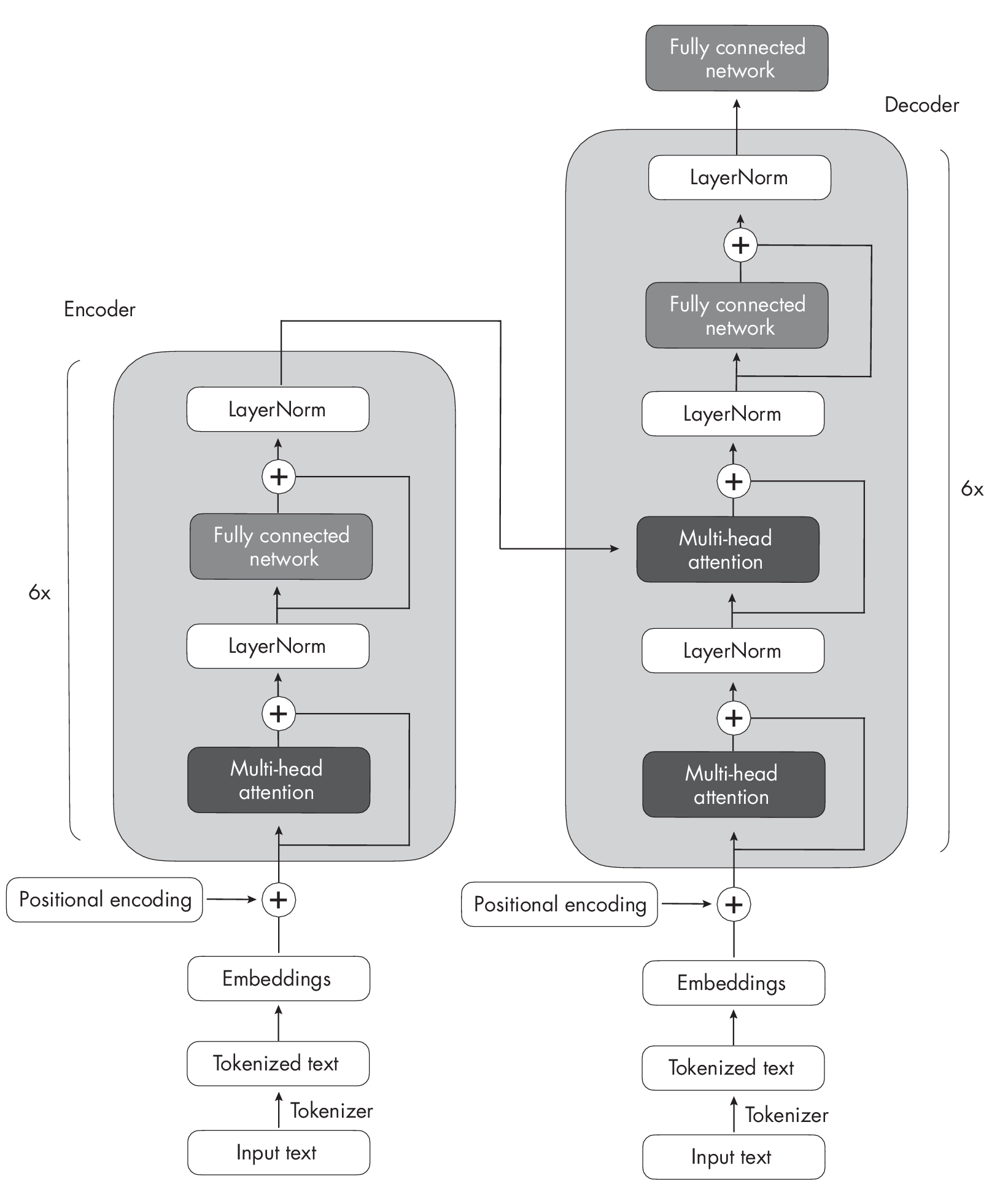
InFigure [fig:ch17-fig01],the input text (that is, the sentences of the text to betranslated) is first tokenized into individual word tokens, which are then encoded via an embedding layer before they enter the encoder part (see Chapter [ch01] for more on embeddings). After a positional encoding vector is added to each embedded word,the embeddings go through a multi-head self-attention layer. This layer is followed by an addition step, indicated by a plus sign (+) in Figure [fig:ch17-fig01], which performs a layer normalization and adds the original embeddings via a skip connection,also known as a residual or shortcut connection. Following this is a LayerNormblock, short for layernormalization, which normalizes the activations of the previous layer to improve the stability of the neural network’s training. The addition of the original embeddings and the layer normalization steps are often summarized as the Add&Normstep. Finally, after entering the fully connected network—a small,multilayer perceptron consisting of two fully connected layers with a nonlinear activation function in between—the outputs are again added and normalized before they are passed to a multi-head self-attention layer of the decoder.
The decoder in Figure [fig:ch17-fig01] has a similar overall structure to the encoder. The key difference is that the inputs and outputs are different: the encoder receives the input text to be translated, while the decoder generates the translated text.
Encoders
The encoder part in the original transformer, as illustrated in Figure [fig:ch17-fig01], is responsible for understanding and extracting the relevant information from the input text. It then outputs a continuous representation (embedding) of the input text, which is passed to the decoder. Finally, the decoder generates the translated text (target language) based on the continuous representation received from the encoder.
Over the years, various encoder-only architectures have been developed based on the encoder module of the original transformer model outlined earlier. One notable example is BERT, which stands for bidirectional encoder representations from transformers.
As noted in Chapter [ch14], BERT is an encoder-only architecture based on the transformer’s encoder module. The BERT model is pretrained on a large text corpus using masked language modeling and next-sentence prediction tasks. Figure 1.1 illustrates the masked language modeling pretraining objective used in BERT-style transformers.
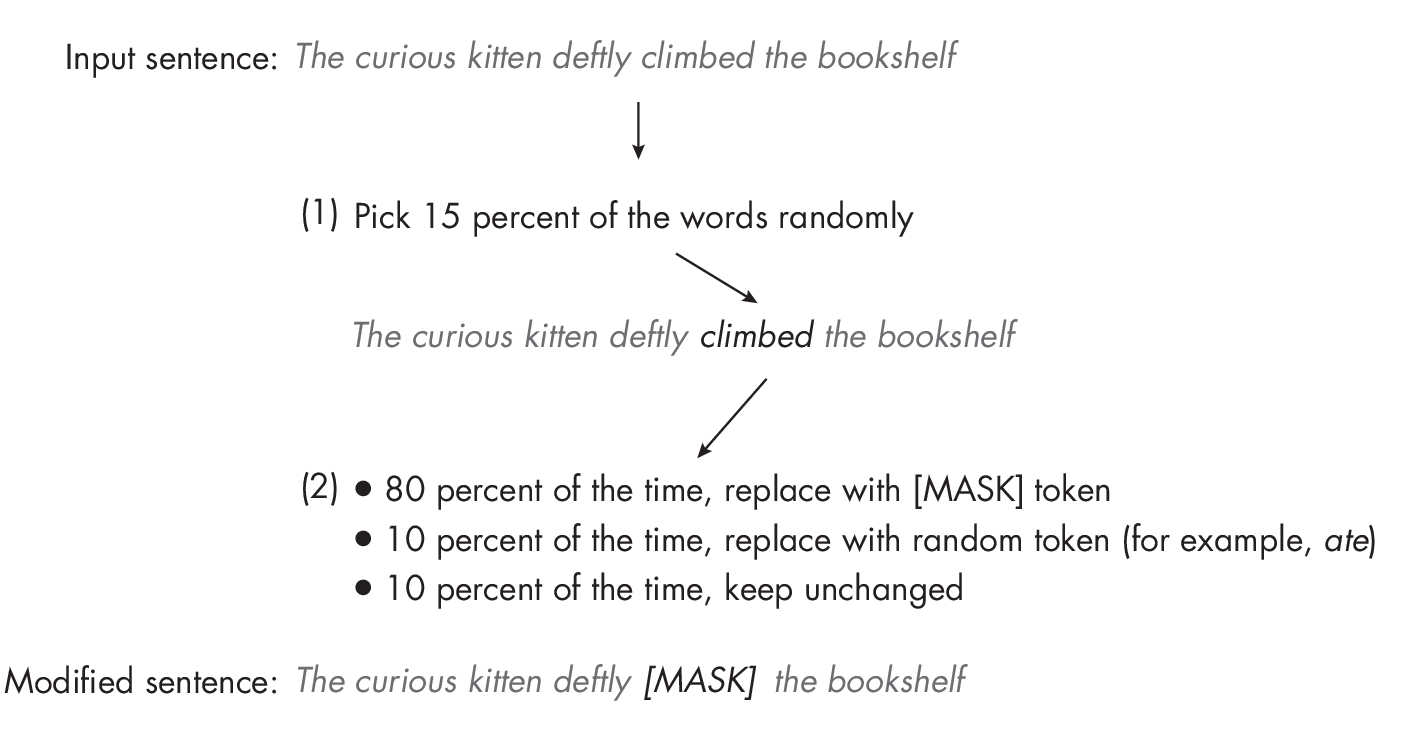
As Figure 1.1 demonstrates, the main idea behind masked language modeling is to mask (or replace) random word tokens in the input sequence and then train the model to predict the original masked tokens based on the surrounding context.
Inadditiontothemaskedlanguagemodelingpretrainingtaskillustrated in Figure 1.1, the next-sentence prediction task asks the model to predict whether the original document’s sentence order of two randomly shuffled sentences is correct. For example, say that two sentences, in random order, are separated by the [SEP] token (SEP is short for separate). The brackets are a part of the token’s notation and are used to make it clear that this is a special token as opposed to a regular word in the text. BERT-style transformers also use a [CLS] token. The [CLS] token serves as a placeholder token for the model, prompting the model to return a True or False label indicating whether the sentences are in the correct order:
-
“[CLS] Toast is a simple yet delicious food. [SEP] It’s often served with butter, jam, or honey.”
-
“[CLS] It’s often served with butter, jam, or honey. [SEP] Toast is a simple yet delicious food.”
The masked language and next-sentence pretraining objectives allow BERT to learn rich contextual representations of the input texts, which can then be fine-tuned for various downstream tasks like sentiment analysis, question answering, and named entity recognition. It’s worth noting that this pretraining is a form of self-supervised learning (see Chapter [ch02] for more details on this type of learning).
RoBERTa, which stands for robustly optimized BERT approach, is an improved version of BERT. It maintains the same overall architecture as BERT but employs several training and optimization improvements, such as larger batch sizes, more training data, and eliminating the next-sentence prediction task. These changes have resulted in RoBERTa achieving better performance on various natural language understanding tasks than BERT.
Decoders
Coming back to the original transformer architecture outlined in Figure [fig:ch17-fig01], the multi-head self-attention mechanism in the decoder is similar to the one in the encoder, but it is masked to prevent the model from attending to future positions, ensuring that the predictions for position i can depend only on the known outputs at positions less than i. As illustrated in Figure [fig:ch17-fig03], the decoder generates the output word by word.
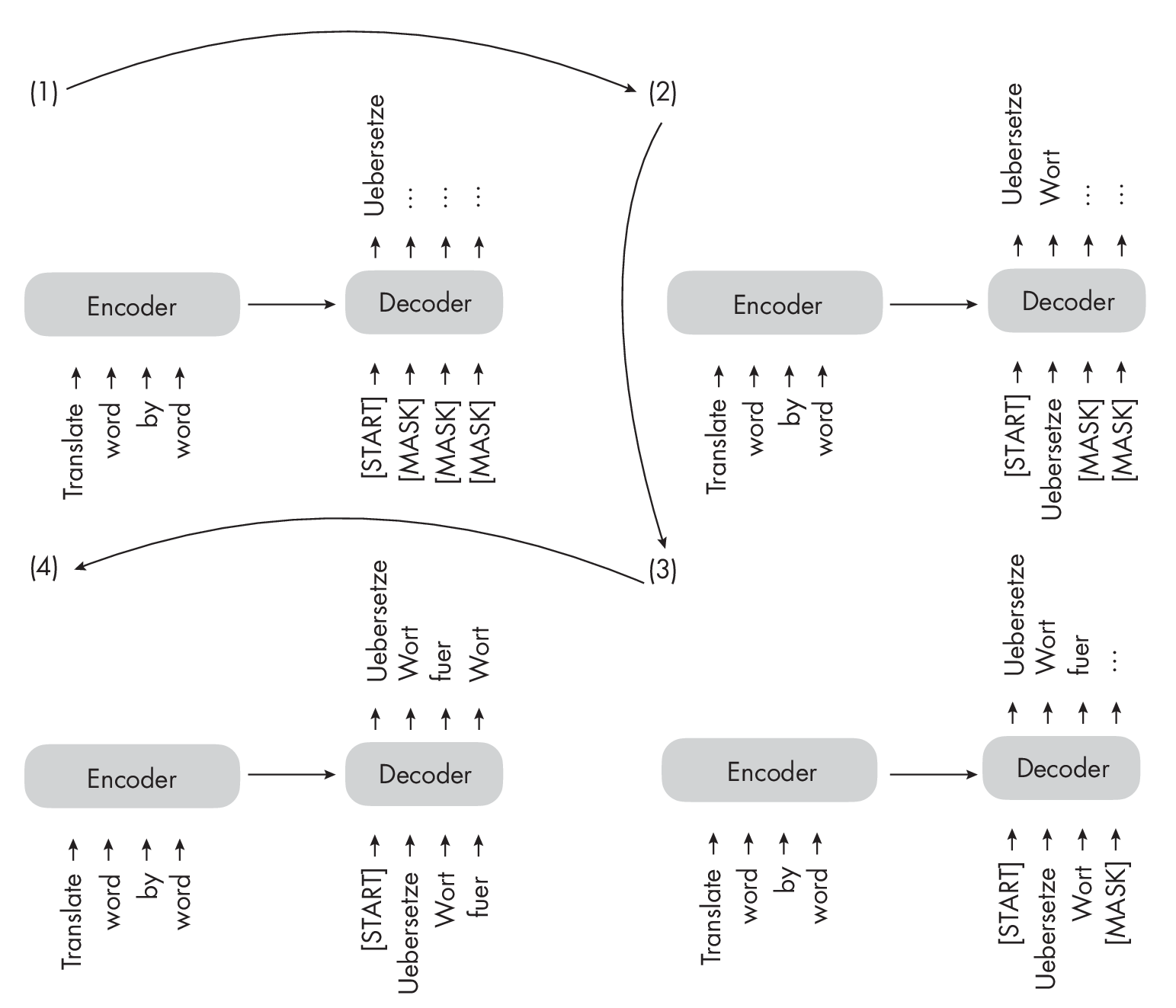
This masking (shown explicitly in Figure [fig:ch17-fig03], although it occurs internally in the decoder’s multi-head self-attention mechanism) is essential to maintaining the transformer model’s autoregressive property during training and inference. This autoregressive property ensures that the model generates output tokens one at a time and uses previously generated tokens as context for generating the next word token.
Over the years, researchers have built upon the original encoder-decoder transformer architecture and developed several decoder-only models that have proven highly effective in various natural language processing tasks. The most notable models include the GPT family, which we briefly discussed in Chapter [ch14] and in various other chapters throughout the book. GPT stands for generative pretrained transformer. The GPT series comprises decoder-only models pretrained on large-scale unsupervised text data and fine-tuned for specific tasks such as text classification, sentiment analysis, question answering, and summarization. The GPT models, including at the time of writing GPT-2, GPT-3, and GPT-4, have shown remarkable performance in various benchmarks and are currently the most popular architecture for natural language processing.
One of the most notable aspects of GPT models is their emergent properties. Emergent properties are the abilities and skills that a model develops due to its next-word prediction pretraining. Even though these models were taught only to predict the next word, the pretrained models are capable of text summarization, translation, question answering, classification, and more. Furthermore, these models can perform new tasks without updating the model parameters via in-context learning, which we’ll discuss in more detail in Chapter [ch18].
Encoder-Decoder Hybrids
Next to the traditional encoder and decoder architectures, there have been advancements in the development of new encoder-decoder models that lev- erage the strengths of both components. These models often incorporate novel techniques, pretraining objectives, or architectural modifications to enhance their performance in various natural language processing tasks. Some notable examples of these new encoder-decoder models include BART and T5.
Encoder-decoder models are typically used for natural language processing tasks that involve understanding input sequences and generating output sequences, often with different lengths and structures. They are particularly good at tasks where there is a complex mapping between the input and output sequences and where it is crucial to capture the relationships between the elements in both sequences. Some common use cases for encoder-decoder models include text translation and summarization.
Terminology
All of these methods—encoder-only, decoder-only, and encoder-decoder models—are sequence-to-sequence models (often abbreviated as seq2seq). While we refer to BERT-style methods as “encoder-only,” the description may be misleading since these methods also decode the embeddings into output tokens or text during pretraining. In other words, both encoder-only and decoder-only architectures perform decoding.
However, the encoder-only architectures, in contrast to decoder-only and encoder-decoder architectures, don’t decode in an autoregressive fashion. Autoregressive decoding refers to generating output sequences one token at a time, conditioning each token on the previously generated tokens. Encoder-only models do not generate coherent output sequences in this manner. Instead, they focus on understanding the input text and producing task-specific outputs, such as labels or token predictions.
Contemporary Transformer Models
In brief, encoder-style models are popular for learning embeddings used in classification tasks, encoder-decoder models are used in generative tasks where the output heavily relies on the input (for example, translation and summarization), and decoder-only models are used for other types of generative tasks, including Q&A. Since the first transformer architecture emerged, hundreds of encoder-only, decoder-only, and encoder-decoder hybrids have been developed, as diagrammed in Figure 1.2.
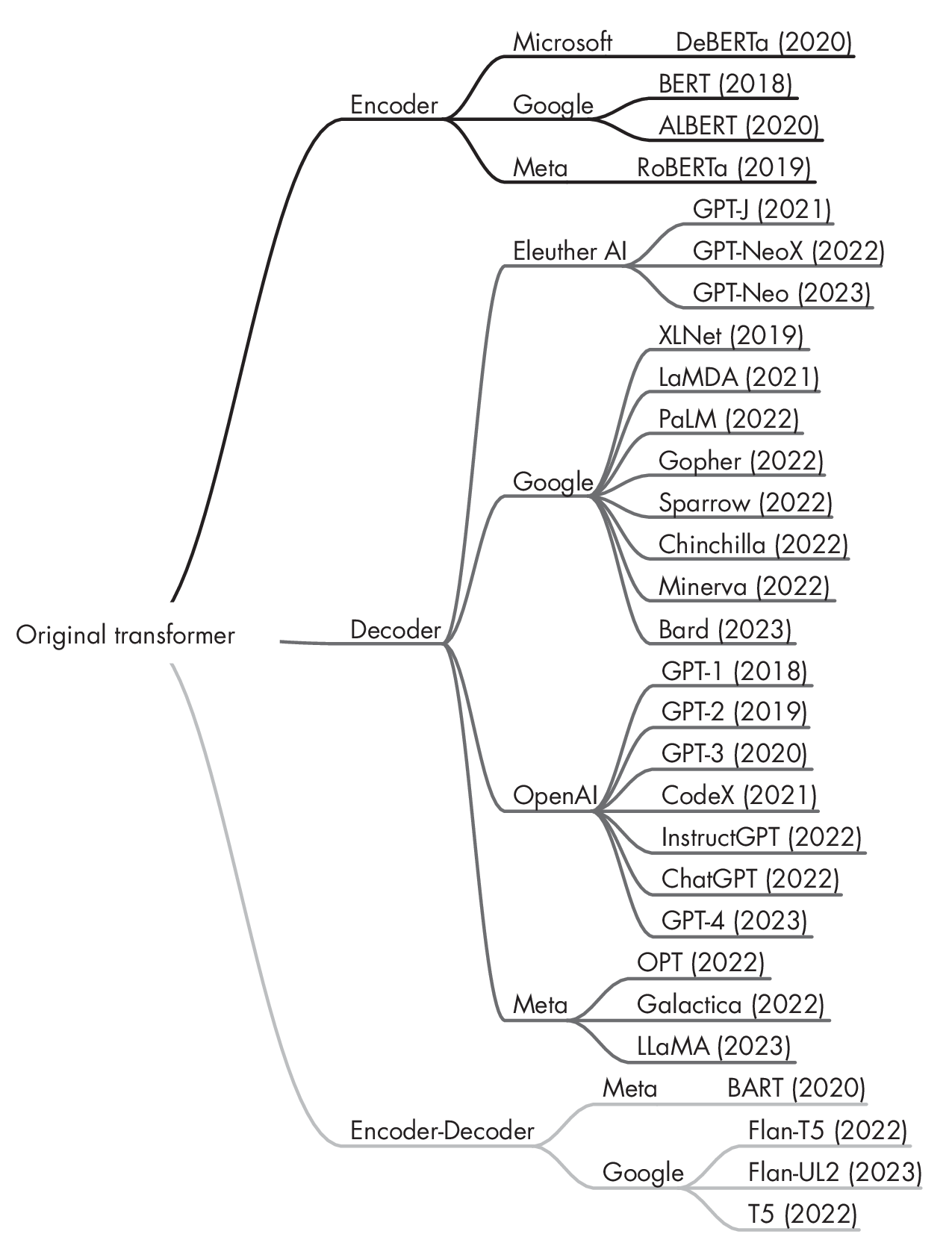
architecture type and developer
While encoder-only models have gradually become less popular, decoder-only models like GPT have exploded in popularity, thanks to breakthroughs in text generation via GPT-3, ChatGPT, and GPT-4. However, encoder-only models are still very useful for training predictive models based on text embeddings as opposed to generating texts.
Exercises
17-1. As discussed in this chapter, BERT-style encoder models are pretrained using masked language modeling and next-sentence prediction pretraining objectives. How could we adopt such a pretrained model for a classification task (for example, predicting whether a text has a positive or negative sentiment)?
17-2. Can we fine-tune a decoder-only model like GPT for classification?
References
-
The Bahdanau attention mechanism for RNNs: Dzmitry Bahdanau, Kyunghyun Cho, and Yoshua Bengio, “Neural Machine Translation by Jointly Learning to Align and Translate” (2014), https://arxiv.org/abs/1409.0473.
-
The original BERT paper, which popularized encoder-style transformers with a masked word and a next-sentence prediction pretraining objective: Jacob Devlin et al., “BERT: Pre-training of Deep Bidirectional Transformers for Language Understanding” (2018), https://arxiv.org/abs/1810.04805.
-
RoBERTaimprovesuponBERTbyoptimizingtrainingprocedures,usinglargertrainingdatasets,andremovingthenext-sentencepred- ictiontask:YinhanLiuetal.,“RoBERTa:ARobustlyOptimizedBERTPretrainingApproach”(2019),https://arxiv.org/abs/1907.11692.
-
The BART encoder-decoder architecture: Mike Lewis et al., “BART: Denoising Sequence-to-Sequence Pre-training for Natural Language Generation, Translation, and Comprehension” (2018), https://arxiv.org/abs/1910.13461.
-
The T5 encoder-decoder architecture: Colin Raffel et al., “Exploring the Limits of Transfer Learning with a Unified Text-to-Text Transformer” (2019), https://arxiv.org/abs/1910.10683.
-
The paper proposing the first GPT architecture: Alec Radford et al., “Improving Language Understanding by Generative Pre-Training” (2018), https://cdn.openai.com/research-covers/language-unsupervised/language_understanding_paper.pdf.
-
The GPT-2 model: Alec Radford et al., “Language Models Are Unsupervised Multitask Learners” (2019), https://www.semanticscholar.org/paper/Language-Models-are-Unsupervised-Multitask-Learners-Radford-Wu/9405cc0d6169988371b2755e573cc28650d14dfe.
-
The GPT-3 model: Tom B. Brown et al., “Language Models Are Few-Shot Learners” (2020), https://arxiv.org/abs/2005.14165.
Support the Author
You can support the author in the following ways:
- Subscribe to Sebastian's Substack blog
- Purchase a copy on Amazon or No Starch Press
- Write an Amazon review