
Machine Learning Q and AI
30 Essential Questions and Answers on Machine Learning and AI
By Sebastian Raschka. Free to read.
Published by No Starch Press.
Copyright © 2024-2025 by Sebastian Raschka.
Machine learning and AI are moving at a rapid pace. Researchers and practitioners are constantly struggling to keep up with the breadth of concepts and techniques. This book provides bite-sized bits of knowledge for your journey from machine learning beginner to expert, covering topics from various machine learning areas. Even experienced machine learning researchers and practitioners will encounter something new that they can add to their arsenal of techniques.
📘 Print Book:
Amazon
No Starch Press
📄 Read Online:
Full Book (Free)
Part 3: Natural Language Processing
Chapter 14: The Distributional Hypothesis
What is the distributional hypothesis in natural language processing (NLP)? Where is it used, and how far does it hold true?
The distributional hypothesis is a linguistic theory suggesting that words occurring in the same contexts tend to have similar meanings, according to the original source, “Distributional Structure” by Zellig S. Harris. Succinctly, the more similar the meanings of two words are, the more often they appear in similar contexts.
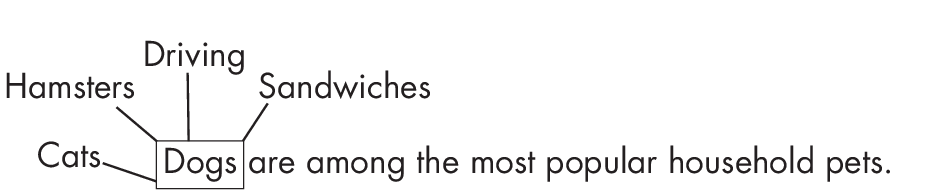
Consider the sentence in Figure 1.1, for example. The words cats and dogs often occur in similar contexts, and we could replace cats with dogs without making the sentence sound awkward. We could also replace cats with hamsters, since both are mammals and pets, and the sentence would still sound plausible. However, replacing cats with an unrelated word such as sandwiches would render the sentence clearly wrong, and replacing cats with the unrelated word driving would also make the sentence grammatically incorrect.
It is easy to construct counterexamples using polysemous words, that is, words that have multiple meanings that are related but not identical. For example, consider the word bank. As a noun, it can refer to a financial institution, the “rising ground bordering a river,” the “steep incline of a hill,” or a “protective cushioning rim” (according to the Merriam-Webster dictionary). It can even be a verb: to bank on something means to rely or depend on it. These different meanings have different distributional properties and may not always occur in similar contexts.
Nonetheless, the distributional hypothesis is quite useful. Word em- beddings (introduced in Chapter [ch01]) such as Word2vec, as well as many large language transformer models, rely on this idea. This includes the masked language model in BERT and the next-word pretraining task used in GPT.
Word2vec, BERT, and GPT
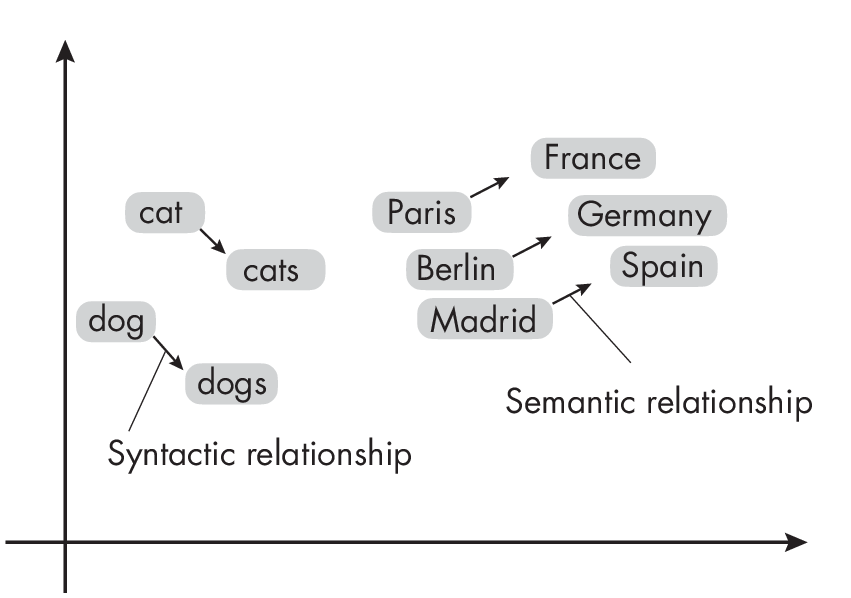
The Word2vec approach uses a simple,two-layer neuralnetwork to encode words into embedding vectors such that the embedding vectors of similar words are both semantically and syntactically close. There are two ways to train a Word2vec model: the continuous bag-of-words (CBOW) approach and the skip-gram approach.When using CBOW, the Word2vec model learns to predict the current words by using the surrounding context words. Conversely, in the skip-gram model, Word2vec predicts the context words from a selected word. While skip-gram is more effective for infrequent words, CBOW is usually faster to train.
After training, word embeddings are placed within the vector space so that words with common contexts in the corpus—that is, words with semantic and syntactic similarities—are positioned close to each other, as illustrated in Figure 1.2. Conversely, dissimilar words are located farther apart in the embedding space.
vector space
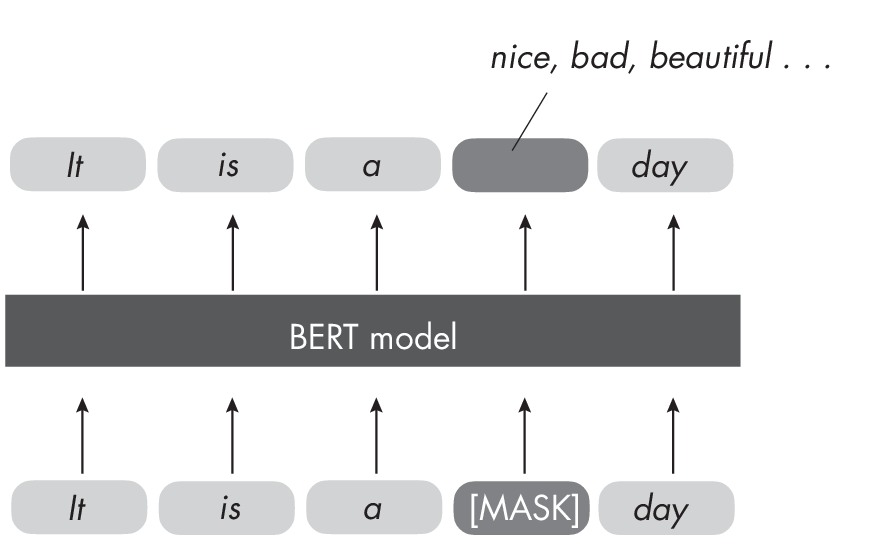
BERT is an LLM based on the transformer architecture (see Chapter [ch08]) that uses a masked language modeling approach that involves masking (hiding) some of the words in a sentence. Its task is to predict these masked words based on the other words in the sequence, as illustrated in Figure 1.3. This is a form of the self-supervised learning used to pretrain LLMs (see Chapter [ch02] for more on self-supervised learning). The pretrained model produces embeddings in which similar words (or tokens) are close in the embedding space.
randomly masked words.
GPT, which like BERT is also an LLM based on the transformer architecture, functions as a decoder. Decoder-style models like GPT learn to predict subsequent words in a sequence based on the preceding ones, as illustrated in Figure 1.4. GPT contrasts with BERT, an encoder model, as it emphasizes predicting what follows rather than encoding the entire sequence simultaneously.
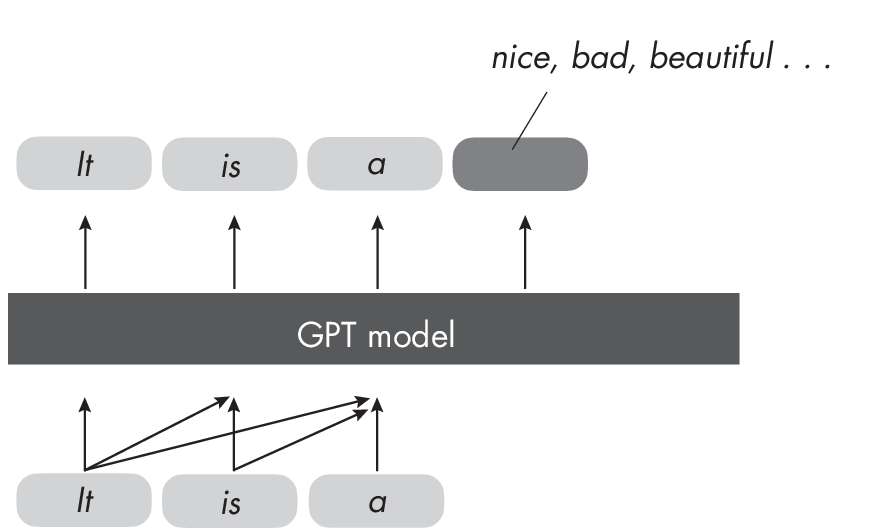
next word.
Where BERT is a bidirectional language model that considers the whole input sequence, GPT only strictly parses previous sequence elements. This means BERT is usually better suited for classification tasks, whereas GPT is more suited for text generation tasks. Similar to BERT, GPT produces high-quality contextualized word embeddings that capture semantic similarity.
Does the Hypothesis Hold?
For large datasets, the distributional hypothesis more or less holds true, making it quite useful for understanding and modeling language patterns, word relationships, and semantic meanings. For example, this concept enables techniques like word embedding and semantic analysis, which, in turn, facilitate natural language processing tasks such as text classification, sentiment analysis, and machine translation.
In conclusion, while there are counterexamples in which the distributional hypothesis does not hold, it is a very useful concept that forms the cornerstone of modern language transformer models.
Exercises
14-1. Does the distributional hypothesis hold true in the case of homophones, or words that sound the same but have different meanings, such as there and their?
14-2. Can you think of another domain where a concept similar to the distributional hypothesis applies? (Hint: think of other input modalities for neural networks.)
References
-
The original source describing the distributional hypothesis: Zellig S. Harris, “Distributional Structure” (1954), https://doi.org/10.1080/ 00437956.1954.11659520.
-
The paper introducing the Word2vec model: Tomas Mikolov et al., “Efficient Estimation of Word Representations in Vector Space” (2013), https://arxiv.org/abs/1301.3781.
-
The paper introducing the BERT model: Jacob Devlin et al., “BERT: Pre-training of Deep Bidirectional Transformers for Language Understanding” (2018), https://arxiv.org/abs/1810.04805.
-
The paper introducing the GPT model: Alec Radford and Karthik Narasimhan, “Improving Language Understanding by Generative Pre-Training” (2018), https://www.semanticscholar.org/paper/Improving -Language-Understanding-by-Generative-Radford-Narasimhan/cd18800a0 fe0b668a1cc19f2ec95b5003d0a5035.
-
BERT produces embeddings in which similar words (or tokens) are close in the embedding space: Nelson F. Liu et al., “Linguistic Knowledge and Transferability of Contextual Representations” (2019), https://arxiv.org/abs/1903.08855.
-
The paper showing that GPT produces high-quality contextualized word embeddings that capture semantic similarity: Fabio Petroni et al., “Language Models as Knowledge Bases?” (2019), https://arxiv.org/abs/1909.01066.
Support the Author
You can support the author in the following ways:
- Subscribe to Sebastian's Substack blog
- Purchase a copy on Amazon or No Starch Press
- Write an Amazon review