
Machine Learning Q and AI
30 Essential Questions and Answers on Machine Learning and AI
By Sebastian Raschka. Free to read.
Published by No Starch Press.
Copyright © 2024-2025 by Sebastian Raschka.

Machine learning and AI are moving at a rapid pace. Researchers and practitioners are constantly struggling to keep up with the breadth of concepts and techniques. This book provides bite-sized bits of knowledge for your journey from machine learning beginner to expert, covering topics from various machine learning areas. Even experienced machine learning researchers and practitioners will encounter something new that they can add to their arsenal of techniques.
📘 Print Book:
Amazon
No Starch Press
📄 Read Online:
Full Book (Free)
Chapter 3: Few-Shot Learning
What is few-shot learning? How does it differ from the conventional training procedure for supervised learning?
Few-shot learning is a type of supervised learning for small training sets with a very small example-to-class ratio. In regular supervised learning, we train models by iterating over a training set where the model always sees a fixed set of classes. In few-shot learning, we are working on a support set from which we create multiple training tasks to assemble training episodes, where each training task consists of different classes.
Datasets and Terminology
In supervised learning, we fit a model on a training dataset and evaluate it on a test dataset. The training set typically contains a relatively large number of examples per class. For example, in a supervised learning context, the Iris dataset, which has 50 examples per class, is considered a tiny dataset. For deep learning models, on the other hand, even a dataset like MNIST that has 5,000 training examples per class is considered very small.
In few-shot learning, the number of examples per class is much smaller. When specifying the few-shot learning task, we typically use the term N-way K-shot, where N stands for the number of classes and K stands for the number of examples per class. The most common values are K = 1 or K = 5. For instance, in a 5-way 1-shot problem, there are five classes with only one example each. Figure 1.1 depicts a 3-way 1-shot setting to illustrate the concept with a smaller example.
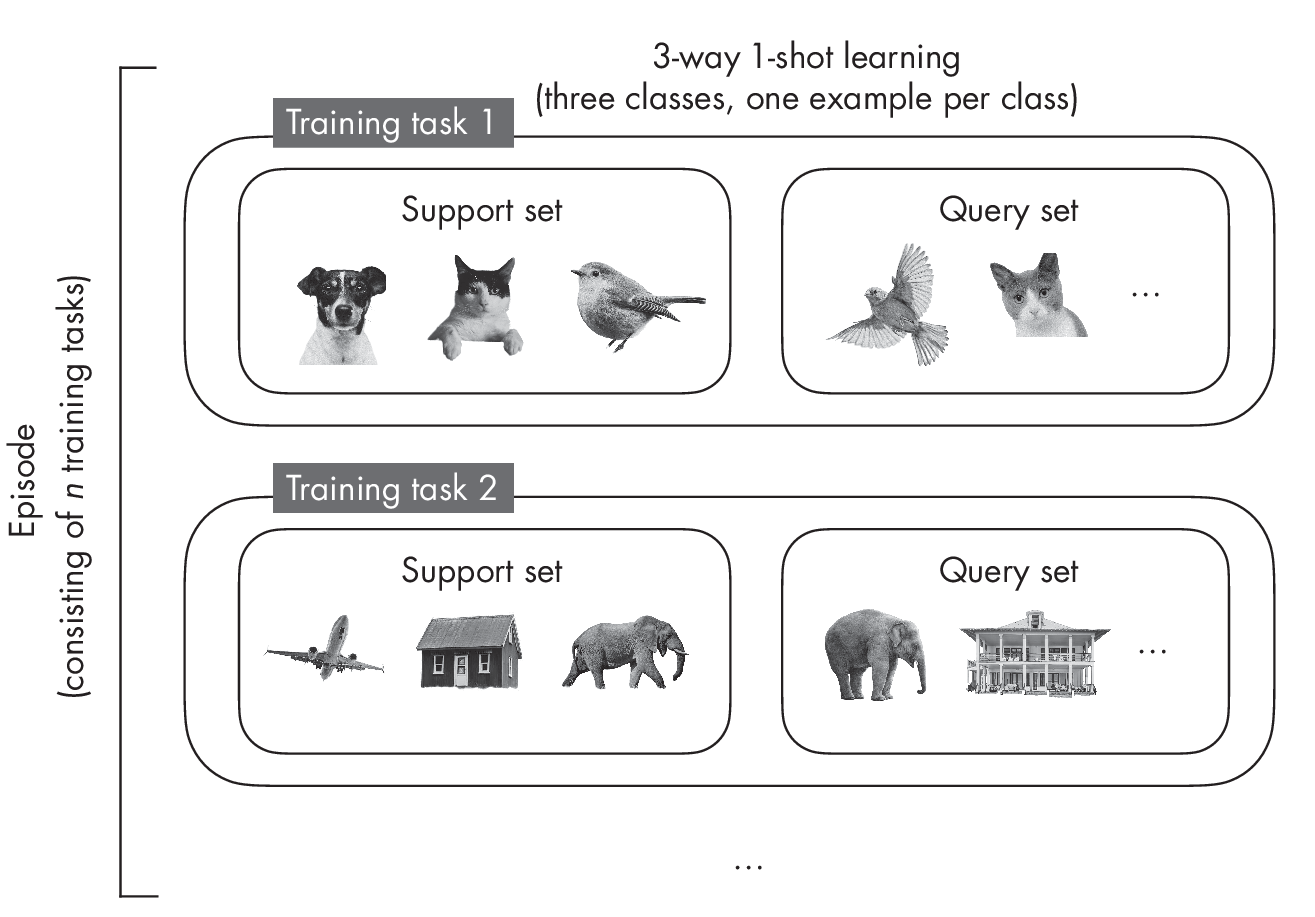
Rather than fitting the model to the training dataset, we can think of few-shot learning as “learning to learn.” In contrast to supervised learn- ing, few-shot learning uses not a training dataset but a so-called support set, from which we sample training tasks that mimic the use-case scenario during prediction. With each training task comes a query image to be classified. The model is trained on several training tasks from the support set; this is called an episode.
Next, during testing, the model receives a new task with classes different from those seen during training. The classes encountered in training are also called base classes, and the support set during training is also often called the base set. Again, the task is to classify the query images. Test tasks are similar to training tasks, except that none of the classes during testing overlap with those encountered during training, as illustrated in Figure 1.2.
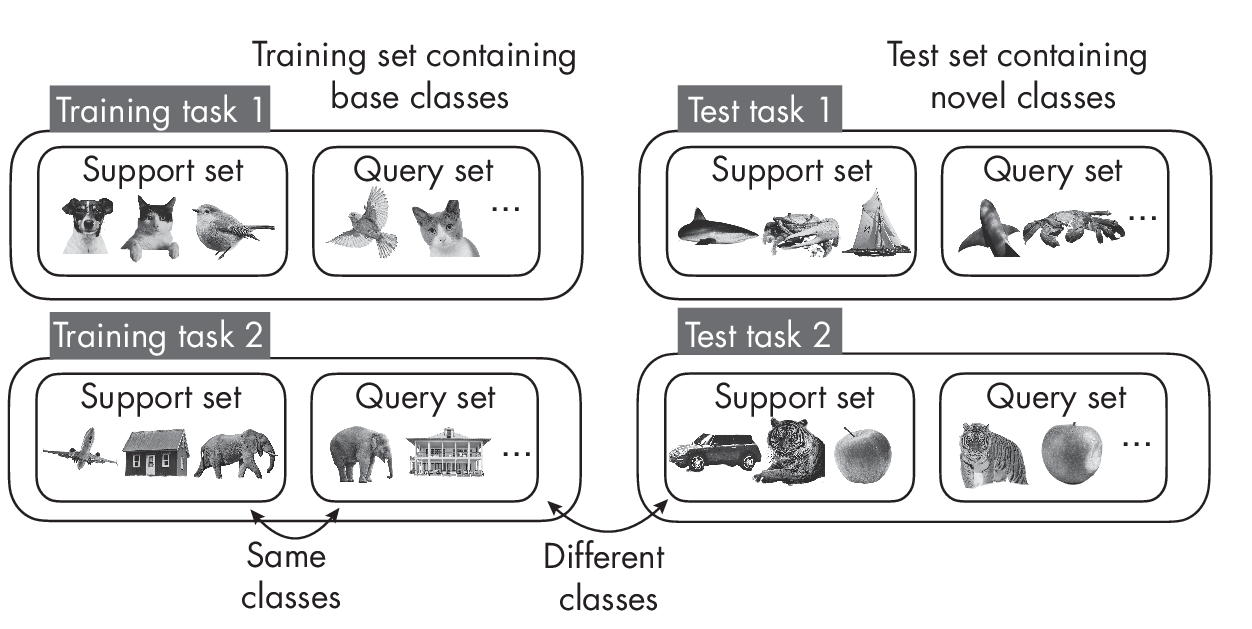
As Figure 1.2 shows, the support and query sets contain different images from the same class during training. The same is true during testing. However, notice that the classes in the support and query sets differ from the support and query sets encountered during training.
There are many different types of few-shot learning. In the most common, meta-learning, training is essentially about updating the model’s parameters such that it can adapt well to a new task. On a high level, one few-shot learning strategy is to learn a model that produces embeddings where we can find the target class via a nearest-neighbor search among the images in the support set. Figure 1.3 illustrates this approach.
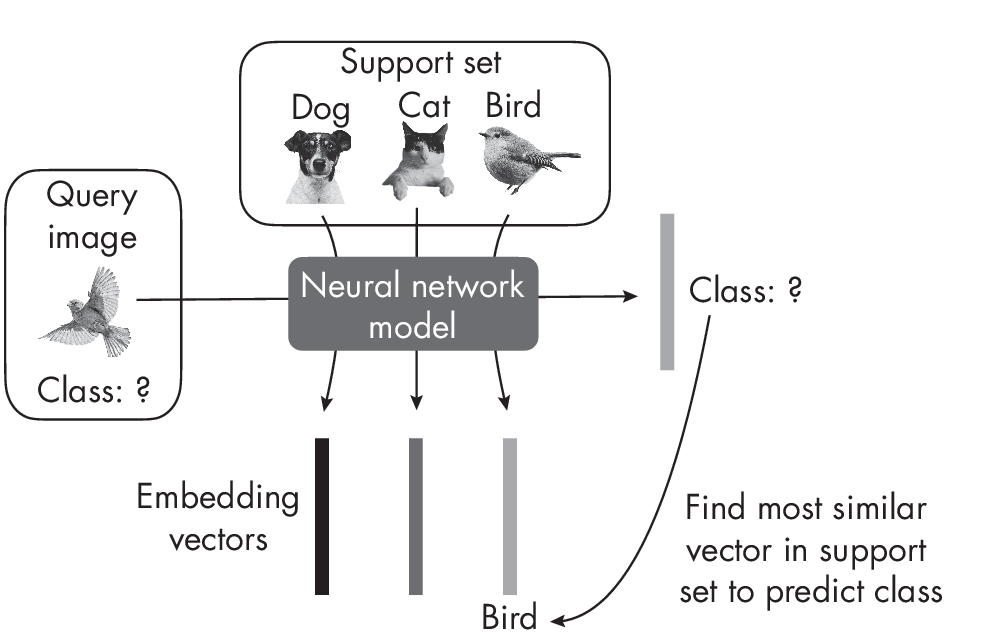
classification
The model learns how to produce good embeddings from the support set to classify the query image based on finding the most similar embedding vector. ### Exercises
3-1. MNIST (https://en.wikipedia.org/wiki/MNIST_database) is a classic and popular machine learning dataset consisting of 50,000 handwritten digits from 10 classes corresponding to the digits 0 to 9. How can we partition the MNIST dataset for a one-shot classification context?
3-2. What are some real-world applications or use cases for few-shot learning?
Support the Author
You can support the author in the following ways:
- Subscribe to Sebastian's Substack blog
- Purchase a copy on Amazon or No Starch Press
- Write an Amazon review